
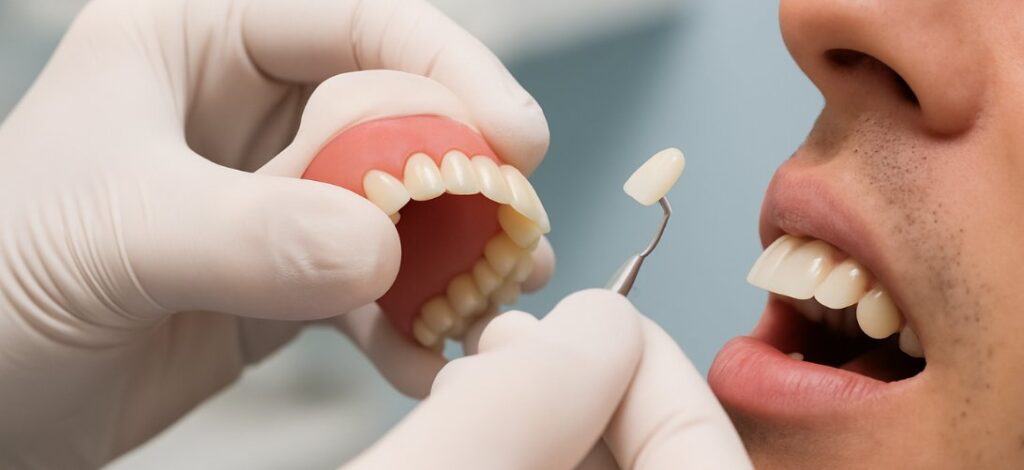
If you are thinking about improving your smile, it is natural to wonder how dental veneers are fitted and what the difference is between porcelain and composite.
At our dental clinic in Alicante we fit dental veneers with an advanced digital protocol that guarantees precision, a natural look and maximum preservation of the tooth.
Dental veneers are one of the most sought-after cosmetic dentistry treatments because they transform the smile in a way that is quick, painless and minimally invasive.
Below we explain step by step what the fitting process is like and what to expect at each stage.
- What are dental veneers and when are they indicated?
- Our protocol at Arroyo & Hernández (Alicante)
- Fitting porcelain veneers: step by step
- Fitting composite veneers in a single visit
- Does it hurt? Anaesthetic, sensitivity and care in the first 48 hours
- Treatment times and number of visits
- Maintenance and real lifespan
- Limitations and contraindications: when NOT to have veneers
- Cost, financing and free first visit
What are dental veneers and when are they indicated?
Dental veneers are very thin shells of porcelain or composite bonded to the front of the teeth.
Their purpose is to improve the shape, colour and alignment of the smile without more invasive treatments.
At Arroyo & Hernández we work with ultra-thin veneers and advanced bonding techniques, which lets us change the look of the tooth with hardly any filing.
The most common cosmetic and functional indications
Veneers are ideal for correcting:
- Stained or discoloured teeth that resist whitening.
- Slight fractures or wear on the biting edge.
- Diastemas (gaps between teeth).
- Uneven or irregularly shaped teeth.
- Slight misalignments or rotations that do not need braces.
Beyond their cosmetic purpose, veneers can help protect worn enamel or reinforce teeth weakened by small cracks.
Porcelain or composite? Key differences and how to choose
We go into full detail in our article on composite vs porcelain veneers. Both materials give excellent results, but each has its own particularities:
- Porcelain veneers: made to measure in a laboratory. They are stronger, keep their shine and colour for years and hardly stain. They are the ideal option when you want maximum durability and a natural look.
- Composite veneers: done directly in the clinic in a single session. They let us change small details and are cheaper and reversible, although they do not last as long (5 to 7 years).
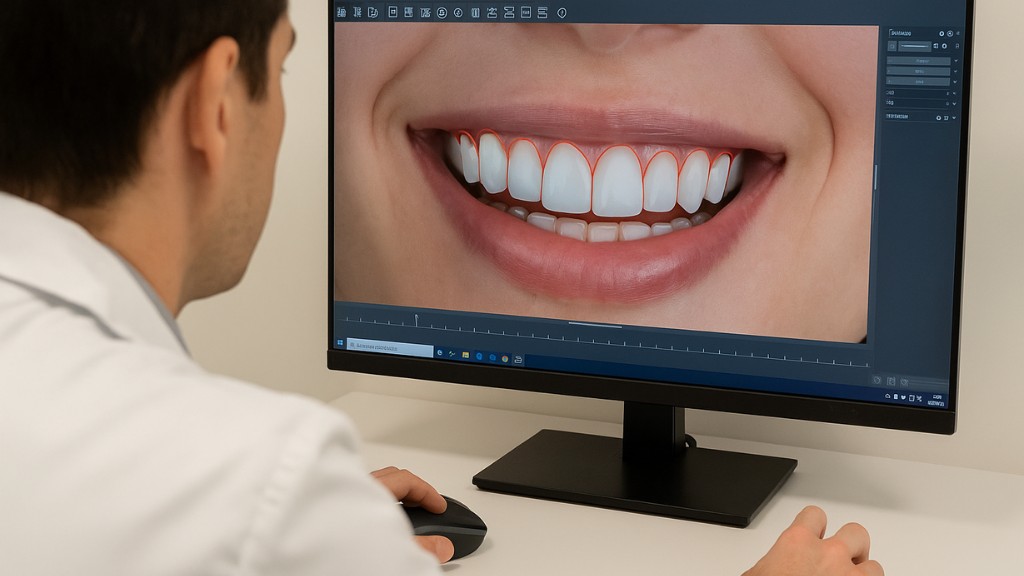
At our clinic we always carry out a prior cosmetic study with DSD (Digital Smile Design) and a 3D intraoral scanner to work out which of the two options fits you best according to your case and expectations.
Our protocol at Arroyo & Hernández (Alicante)
At Arroyo & Hernández Dental Clinic, fitting dental veneers is a completely personalised, digital procedure.
Thanks to technology and the experience of the cosmetic dentistry team, led by Dr Almudena Más, we achieve results that not only improve the smile but also respect the facial and dental harmony of each person.
Our protocol has several stages that let us plan and carry out the treatment with maximum precision:
Digital smile diagnosis (DSD), photos and 3D intraoral scanner
The first step is to get to know your smile in depth. We do a photographic study and a 3D digital scan with our intraoral scanner, which replaces traditional moulds with a quick, comfortable process with no impression putty.
With Digital Smile Design (DSD) technology we analyse your face, your features and the relationship between your lips and teeth. That way we can digitally design how your new smile will look before touching a single tooth.
This lets us adjust the colour, shape and size of each veneer to the millimetre, achieving a natural, well-proportioned smile in balance with your expression.
An individual cosmetic plan: shape, colour and proportion
Every patient has a unique smile. So at this stage we select:
- The ideal colour according to your skin tone and natural brightness.
- The shape and texture that best suits your style (more youthful, more elegant or more natural).
- The proportion and alignment in relation to the rest of the teeth and the face.
This whole process is done visually with you, so you take part in the choices and see what the final result will look like before treatment starts.
Mock-up / trial in the mouth: see the result before you start
Before making or fitting the final veneers, we do a temporary cosmetic trial (mock-up).
This step involves placing a simulation of the final design, made from the digital model, over your teeth. That way you can see and try the real result in your mouth: check the shape, the colour, how it looks when you smile and even how it feels when you talk.
Only when you confirm you are completely happy do we go ahead with making and then fitting the final veneers.
Fitting porcelain veneers: step by step
Porcelain veneers are the strongest and best-looking, since their shine and translucency perfectly mimic natural enamel.
At Arroyo & Hernández we use high-end porcelains and light-cured adhesive bonding systems that ensure a lasting bond.
Minimal or “no-prep” preparation (ultra-thin micro-veneers) depending on the case
In many cases we use ultra-thin or “no-prep” micro-veneers, which need no filing of the tooth or only minimal polishing. That way we keep as much natural enamel as possible, avoiding discomfort and keeping the treatment reversible.
When the case requires it, we do selective filing, limited to a few microns, always under digital control.
Selective preparation and cosmetic temporaries
If slight filing is needed, we fit temporary veneers designed to look good, so you can carry on as normal while the laboratory makes your final veneers.
These temporaries not only protect the tooth but let us fine-tune details before the final result.
Laboratory and personalised design
Porcelain veneers are made in a specialist laboratory, where the ceramic technician works from the digital records and the DSD design.
Each piece is modelled by hand and layered to reproduce the natural luminosity, texture and translucency of enamel.
Trial, adjustment and light-cured adhesive bonding
Once ready, we do the cosmetic and functional trial in the clinic. If everything fits in shape, colour and comfort, we go ahead and bond the veneers using specific adhesives and curing light to ensure a perfect, lasting fixation.
During this process we carefully isolate each tooth, guaranteeing a dry, clean field for optimal bonding.
Final bite checks, polishing and margin sealing
To finish, we check the bite (occlusion), do the final polish and seal the margins to prevent leakage. That gives a finish that is smooth, natural and fully integrated with the rest of your teeth.
The result: a more harmonious, whiter, natural smile that feels identical to your original teeth.
Fitting composite veneers in a single visit
Composite veneers are an excellent alternative when you want a quick, reversible cosmetic change.
They are done directly on the tooth in the clinic, in a single session, with no laboratory needed.
Full isolation, layering and light curing
During the procedure we isolate each tooth to keep out moisture and work by layering the composite, mimicking the colour and translucency of natural enamel.
Each layer is hardened with curing light for a solid, lasting bond.
This type of veneer lets us change the shape or colour of the tooth instantly, with total control over the cosmetic result.
Finishing, advanced polishing and surface texturing
Once the application is finished, we do meticulous polishing and texturing of the composite surface.
This not only improves shine and naturalness but also helps reduce plaque build-up and staining over time.
In a single visit you can leave the clinic with a completely renewed smile, with no need for anaesthetic or filing.
Does it hurt? Anaesthetic, sensitivity and care in the first 48 hours
In general, fitting dental veneers does not hurt. In cases where we do slight filing, we apply a superficial local anaesthetic to keep you comfortable.
After treatment it is normal to feel slight sensitivity to cold or heat during the first 24 to 48 hours, which goes away on its own.
Managing sensitivity and practical tips
During the first few days we recommend:
For any minor discomfort you can take a mild anti-inflammatory, although it is rarely needed.
Treatment times and number of visits
The total time depends on the type of veneer and the number of teeth to treat.
Rough timings: porcelain vs composite
- Porcelain veneers: usually take 2 to 3 visits, with about 10 to 15 days between taking the impressions and the final fitting.
- Composite veneers: fitted in a single session, ideal for anyone who wants immediate results.
How many veneers should you have? (canine to canine, the smile zone)
In most cosmetic cases we fit between 6 and 10 veneers, from canine to canine or up to the first premolars, to achieve a harmonious, balanced smile.
In the prior study we assess whether the lower arch also needs treating or only the front that shows when you smile.
Maintenance and real lifespan
Once the veneers are in, keeping their look and function depends largely on your habits and regular check-ups.
At Arroyo & Hernández Clinic we always insist that the key to long-term success is daily care and professional follow-up.
Under normal conditions, porcelain veneers can last between 10 and 20 years, while composite ones usually stay perfect for 5 to 7 years before needing small touch-ups or partial renewal.
Hygiene, staining habits and regular check-ups
To extend the life of your veneers and keep their natural shine:
- Brush after every meal with a non-abrasive toothpaste and use floss or interdental brushes.
- Avoid habits such as biting pens, ice or your nails.
- Go easy on coffee, tea, red wine and tobacco, especially with composite veneers, since these products can cause staining over time.
- Come for check-ups and professional cleanings every 6 months. That way we can polish the surface, check the seal and make sure everything is still in perfect condition.
These visits are quick and very useful for keeping the treatment going for longer.
Limitations and contraindications: when NOT to have veneers
Although veneers are a safe, minimally invasive treatment, not every case is suitable. Before fitting them we do a thorough study to detect any contraindications.
Decay, inflamed gums, untreated bite problems
Veneers should not be fitted on teeth with active decay, deep fractures or inflamed gums. The cause has to be treated first (whether a root canal, a periodontal cleaning or a filling).
Nor are they advisable where there are severe bite problems (malocclusions) that compromise the stability of the treatment.
In those cases, prior orthodontic treatment may be needed to correct the position of the teeth.
Alternatives: braces, Philips ZOOM whitening, selective bonding
When veneers are not the ideal option, there are equally effective alternatives:
- Invisible braces (Spark or Invisalign): to align the teeth without filing them.
- Philips ZOOM teeth whitening: to improve the colour naturally without touching the tooth structure.
- Cosmetic composite bonding: to correct small imperfections quickly and reversibly.
In every case we look for the most conservative option for your oral health.
Cost, financing and free first visit
At Arroyo & Hernández Clinic we believe cosmetic dentistry should be accessible, which is why we offer tailored financing and a free first visit. Treatment here also works out considerably cheaper than in the UK: write to us or call and we will give you an estimate based on your case.
During the initial assessment we carry out:
- A full digital study with photographs and an intraoral scan.
- A personalised cosmetic plan with a digital simulation of the final result (DSD).
- A fixed, no-obligation quote and a detailed explanation of each stage.
What the quote includes and payment options
Our veneer treatments include:
- Digital diagnosis, design and cosmetic trial (mock-up).
- Handcrafted manufacture in the laboratory or direct modelling in the clinic.
- Fitting, polishing and post-treatment checks.
- Check-ups.
You can also finance the treatment over up to 24 months interest-free.

